
Who is walking whom?
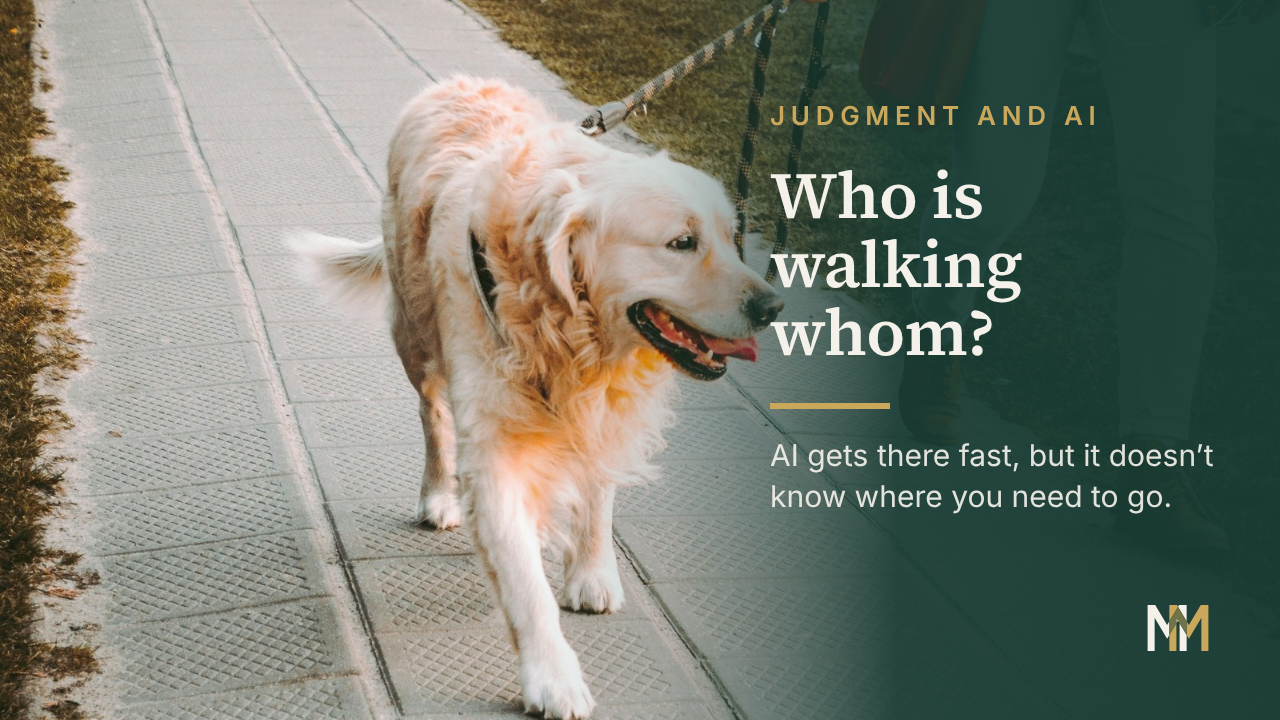
This morning I went out for an early run. At that hour a lot of people take their dogs for a walk, and something caught my attention at almost every corner: more than one owner had their head buried in their phone, and it was the dog choosing the route. It turned where it wanted, stopped where it wanted, crossed when it wanted. The owner followed without looking.
For a moment I thought it wasn't the owner walking the dog. It was the other way around.
I kept running with that image in my head, because it is exactly what I see every day with artificial intelligence.
AI gets there fast, but it doesn't know where you need to go
I use AI in my work and I recommend it. I'm not writing this against the tool. I'm writing it because of what happens when we let go of the leash.
AI always has a route. It answers fast, confidently and in polished language. The problem is that its route isn't always the one you need, and if you aren't watching, you don't notice the detour. You get somewhere, yes. Just not necessarily where you needed to go.
There is a case that worries me more than the distracted user: professionals who start using AI to produce work they were never trained to do. It isn't that they can't do it with the tool. It's that they don't have the judgment to question what the tool gives them.
The $20-a-month business plan
Some time ago, someone told me they had been asked for a business plan and weren't going to pay anyone for it: they would do it with an AI tool.
This is a capable person in their own field, and that field has nothing to do with finance, strategic planning or economics. They have common sense, and common sense helps. But common sense, like truth, depends on who is using it. Mine is not the same as yours.
What they don't have is years of producing that same document again and again. They have never gotten a set of projections wrong and had to explain why. They don't know which assumptions tend to be inflated or what questions the reader will ask. They can check whether the text describes their business, but they don't know what else to check: whether sales grow faster than the industry allows, whether cash holds up in the months when customers pay late, or whether the plan considers what happens when things don't go as projected. And AI won't answer the questions they don't know to ask.
It would be the same as me, someone who comes from finance, deciding tomorrow to operate on a patient by following an AI's instructions. The instructions might be correct. The result would still be a disaster, because I wouldn't recognize the moment something went wrong.
Judgment is not included
Today anyone can ask AI how to build a rocket to the Moon and get a flawless answer. That doesn't make them an astronaut.
AI has something other technologies that distracted us did not: it makes you feel you already know. It gives you the language, the format and the confidence of an expert, and for a while it seems you acquired the experience along with the answer. But inside we are still the same people, with the same strengths and the same weaknesses. What changed is that we now have a tool that makes us believe we can do everything.
Judgment is built another way: with hours, with repetition, with your own mistakes and with the mistakes of others you saw up close. That doesn't come with any monthly plan.
We are the ones doing the replacing
There is a lot of talk about AI replacing jobs. I see something more uncomfortable: it isn't AI that decides to replace people. We do, every time we stop paying for a professional service because we think a subscription can handle it.
And here is the paradox, which I see more often than I'd like: many people who think this way expect, rightly, to be paid for their own expertise. For their work, that argument makes sense. For other people's work, not so much, because that's what AI is for.
I understand that not every business can afford a specialist for every document. But there is a middle ground: use AI to move forward, and ask someone with judgment to review what you don't know how to review. That costs far less than getting it wrong.
Who would have thought that the replacement of human work would start like this: not driven by machines, but by ourselves.
Keep the leash in your hand
I don't think the answer is to stop using AI, any more than it is to stop having a dog. AI is a great tool when it is held by someone who knows where they are going, watches the road and pulls the leash when needed.
By the way: I used AI to organize this text. The ideas, the run and the judgment about what stayed and what didn't were mine. That's the point.
The question I ask myself, and leave with you, is simple: when you use AI, who is walking whom?
Prevuelo Index
Before your next big decision, measure where your company stands in 5 minutes.