
The sterile cockpit: the rule that protects decisions, not pilots
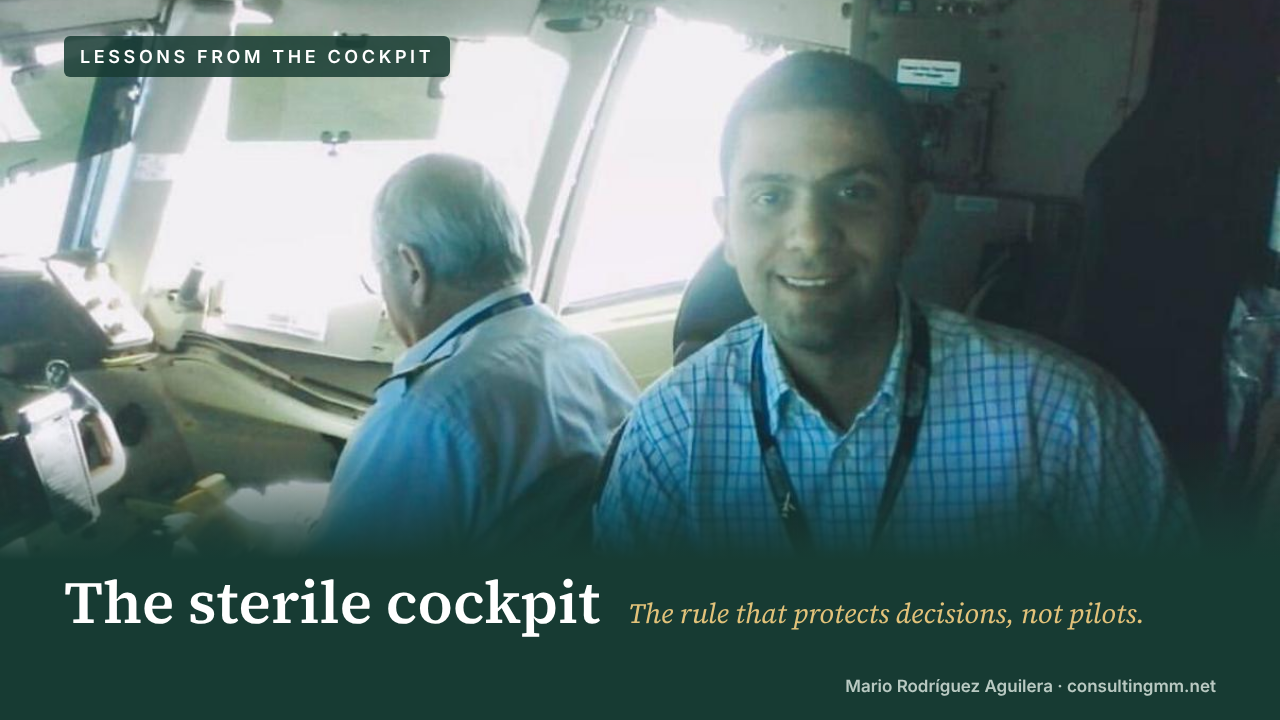
In this photo I am sitting in the jumpseat, the fold-down seat behind the pilots. From there you can see everything: the instruments, the captain's hands, the runway getting closer. And anyone who sits there quickly learns a rule that almost nobody on the ground knows about: at certain moments of the flight, nothing gets discussed in that cockpit except flying.
It is called the sterile cockpit rule. It does not protect a person. It protects a moment: the moment when a bad decision can no longer be undone.
Years later, watching how companies make decisions, I realized that this rule sums up the deepest idea behind what I now call the Prevuelo™ Method.
Two experienced crews
On September 11, 1974, a DC-9 was approaching Charlotte, North Carolina, in fog. In the cockpit, the captain and the first officer were talking about Watergate, the oil crisis, the stock market and used cars. Then they got distracted trying to identify a tower in the landscape. They lost track of their altitude, and the airplane hit the ground short of the runway. Seventy-two people died. The National Transportation Safety Board (NTSB) concluded that the cause was the crew's lack of altitude awareness "due to poor cockpit discipline."
That accident and others like it led the Federal Aviation Administration (FAA) to issue rule 121.542 in 1981. During critical phases of flight (taxi, takeoff, landing and all operations below 10,000 feet, except cruise), pilots may not do anything that is not required for the safe operation of the aircraft. That includes conversations unrelated to the flight.
Seven years later, the rule was already in place. On August 31, 1988, a Boeing 727 was waiting its turn to take off at Dallas/Fort Worth. While they taxied and waited, the crew chatted with a flight attendant about the presidential election, about other accidents and about personal matters. They took off without extending the flaps, the surfaces an airplane needs to lift off at low speed. A warning that should have alerted them did not sound either. Fourteen people died. The NTSB wrote that the cause was "inadequate cockpit discipline."
Neither crew was inexperienced. They knew how to fly and they knew the procedures. The second case is even more uncomfortable: the rule was written down, and it was not followed.
What the rule understands about people
The sterile cockpit rule does not start from the idea that pilots are careless. It starts from something more honest: human attention is limited, and it fails most precisely when the workload is highest, regardless of experience.
That is why it is built from four pieces, and each one is worth a closer look:
It is decided on the ground, not in the air. Nobody in the cockpit has to judge, in the middle of an approach, whether this is a good time to chat. The decision was made beforehand, calmly, by people who were not under pressure.
It is triggered by data, not by a feeling. The rule does not say "when the moment seems delicate." It says "below 10,000 feet." The altimeter decides, not the crew's mood.
It has a clear scope. It states what is allowed and what is not. And it applies to everyone: the captain, the first officer, the cabin crew and whoever is observing from the jumpseat.
It defines the exception. If something affects the safety of the flight, you speak up. Always. The rule is not about silence: it is about letting in only what matters.
NASA researchers spent years studying why expert crews skip steps they know by heart. One of their conclusions, collected in the book The Multitasking Myth (2009), is that interruptions and workload make even the best professionals leave things out without realizing it. The solution was not to ask them to try harder. It was to design the environment so that omissions are harder to make.
The heart of the Prevuelo Method
When a small or mid-sized company gets into trouble, it is almost never for lack of effort or information. The owner works from dawn to dusk and, in general, has the numbers somewhere. The problem is a different one: big decisions are made in the air.
You hire because the team is overloaded that week. You sign the loan the day the bank calls. You open the new location because the space became available. You lower the price in the middle of a negotiation. All with the airplane already moving, under pressure, with the phone ringing and without criteria defined in advance.
Prevuelo exists to move those decisions back to the ground. It is the same logic as the sterile cockpit, applied to a company: decide calmly, in advance, the rules that will govern the moments when we decide worst. That happens in three parts.
1. Know where you stand before you move. Before an airplane takes off, maintenance signs off that it is airworthy. In a company, that means measuring: how much free cash you have, how many months of essential outflows it covers, how much debt the operation carries and whether the rules you wrote are actually followed. Without that starting point, every decision is intuition.
2. Set your points of no return before you need them. On every takeoff there is a speed beyond which the pilot can no longer stop, and it is calculated on the ground. In a company, before committing money you cannot get back (a contract, a hire, an investment), you define the condition that must be met. For example, confirmed revenue, not just expected revenue. If the condition is not met, you do not go ahead, even if the moment seems perfect.
3. Install alarms with concrete thresholds. An airplane does not wait for the pilot to "feel" that something is wrong: there are alarms with defined limits. In a company, an alarm is triggered by data. For example, when free cash covers less than two months of essential outflows, or when gross margin falls for two quarters in a row.
This is the thread that ties everything together: the sterile cockpit, the point of no return and the alarm are the same idea. A decision made on the ground that triggers itself in the air. What Prevuelo seeks, at its core, is for the company to work the way it was designed and the way it is written down, not according to the mood of the day.
Your 10,000 feet
If we bring the rule into a company, two kinds of critical phases appear.
The ones on the calendar. The monthly close, the cash review, payroll and tax payments, preparing for a meeting with the bank. You know when they are coming. They are like takeoff and landing: they always happen, in the same order.
The ones an alarm triggers. This is the part almost nobody thinks about. When an indicator crosses its threshold, for example when cash covers less than two months of outflows, the company drops below 10,000 feet. At that moment the rule should change for everyone: the only topic is flying the airplane. Collect, slow down outflows, renegotiate, protect the operation. New projects, non-urgent hires and brilliant ideas wait until the company climbs back up.
In most small businesses the opposite happens. Critical moments are the ones with the most interruptions: the WhatsApp messages that never stop, the "got a minute?", the meeting that ran over. And when cash gets tight, owners tend to make more decisions, not fewer, with less information.
What an interruption costs
This is not a matter of character. It is how attention works.
Gloria Mark, a researcher at the University of California, Irvine, closely shadowed managers, financial analysts and engineers for three days. She found that they switched activities every three minutes, and that when a task was interrupted, it took them an average of 23 minutes and 15 seconds to get back to it, with two other tasks in between.
In a hospital, the cost is measured differently. A study published in 2010 in Archives of Internal Medicine observed 98 nurses as they administered more than 4,000 medications. Each interruption was associated with a 12.7% increase in clinical errors. With three interruptions, the error rate rose from 25% to almost 39%.
Your monthly close is not a landing in fog or a medication dose. But the mind reviewing your numbers is the same, and it fails in the same way when it is interrupted.
How to install a sterile cockpit in your company
1. Write down your critical phases. Three to five from the calendar and one or two triggered by an alarm. If everything is critical, nothing is.
2. Give them an objective trigger. A date and time ("the first three days of the month, 8 to 11 a.m.") or a data point ("free cash below two months"). Never a feeling.
3. Define what gets in and what does not. During those windows, only what affects the decision at hand gets in. Everything else waits, even if it is urgent for whoever is asking.
4. Make it apply to everyone, starting with you. In the cockpit, the rule binds the captain first. If the owner is the first to break it, nobody will respect it.
5. Define the emergency. Agree on what justifies breaking the rule: a large client canceling, a rejected payment, a legal problem. Nothing else.
6. Review it when you are at cruise. Rules are adjusted on the ground or at cruise, never on approach. Once a quarter, check whether your phases and thresholds are still the right ones.
What a sterile cockpit is not
It is not silence or isolation. At cruise, the cockpit talks, coordinates and shares information all the time. Nor is it bureaucracy: it is a handful of rules, written once, that save dozens of decisions under pressure.
It is acknowledging something aviation learned at a very high cost: experience does not protect you from distraction. What protects you is having decided in advance.
Which critical phase in your company is flown with the most interruptions today?
Sources
- National Transportation Safety Board, accident reports for Eastern Air Lines 212 (1974) and Delta Air Lines 1141 (1988).
- SKYbrary, "Sterile Flight Deck" (FAR 121.542, critical phases of flight, 1981).
- Loukopoulos, Dismukes and Barshi, The Multitasking Myth: Handling Complexity in Real-World Operations, 2009.
- Gallup Business Journal, interview with Gloria Mark, 2006.
- Westbrook J. I. et al., Archives of Internal Medicine, 2010;170(8):683-690.
Free guide: the Prevuelo Method
The checklist, the four alarms and the questions to ask before committing money, in one PDF.