
Safe in the air, fragile on the ground
Why the industry that manages operational risk best does not always manage its own money the same way, and what any company can learn from that
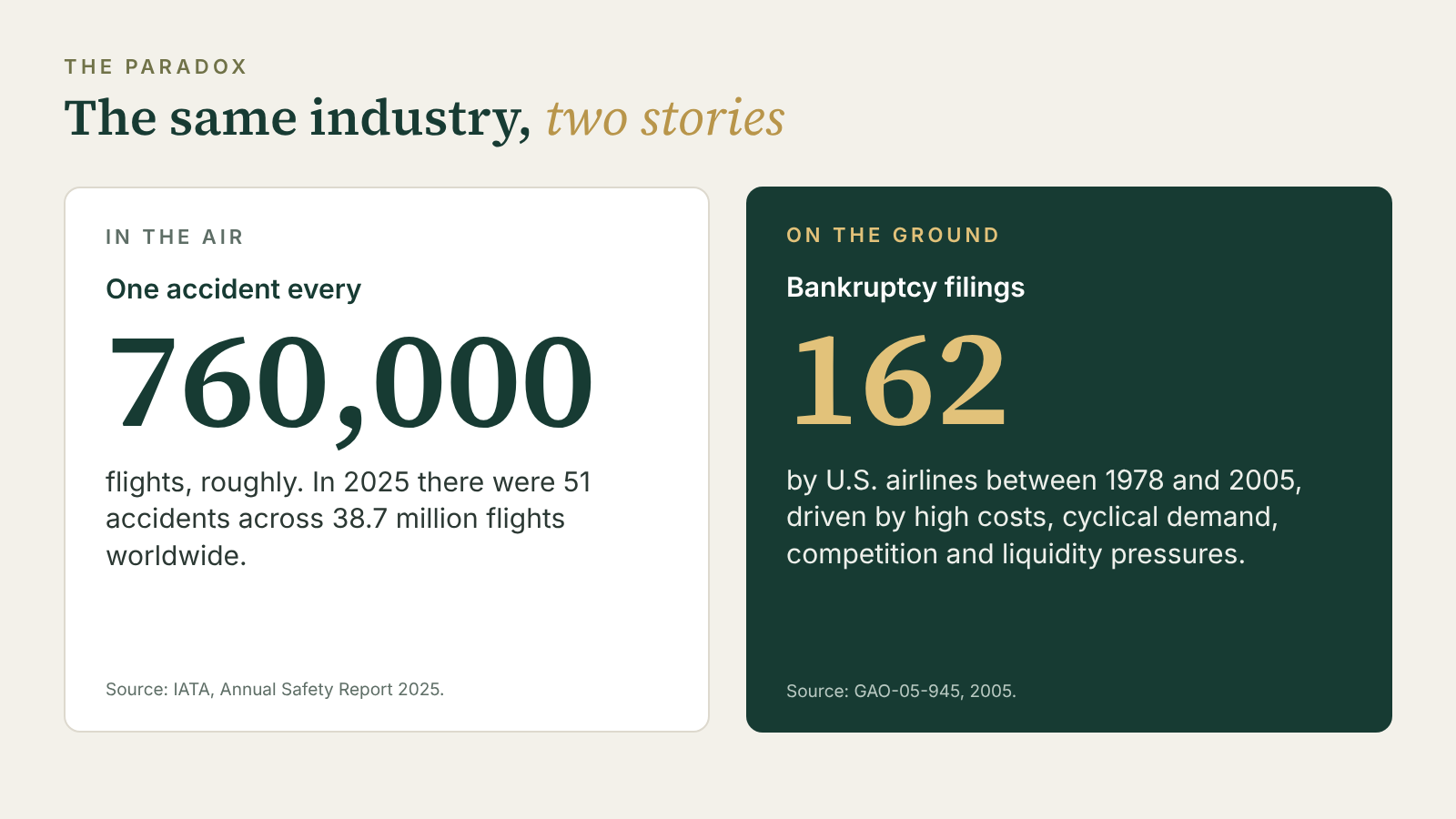
In 2025, the world's airlines operated 38.7 million flights. According to the annual safety report of the International Air Transport Association (IATA), there were 51 accidents in total. That is a rate of 1.32 per million flights: roughly one accident every 760,000 takeoffs.
Few human activities manage risk with that kind of precision. And yet the same industry that achieves that number has a very different financial history.
What the U.S. record shows
In 2005, the U.S. Government Accountability Office (GAO) studied the state of the country's airlines. Its conclusion starts with a number: since deregulation in 1978, there had been 162 airline bankruptcy filings, 22 of them in the previous five years.
GAO did not attribute those bankruptcies to accidents or technical failures. It pointed to high fixed costs, cyclical demand and intense competition. And it added something more revealing: airlines used bankruptcy in response to liquidity pressures and as a way to restructure their costs. Legacy airlines also compensated for operating losses by taking on more debt.
The pattern did not stay in the past. Spirit Airlines filed for bankruptcy protection in November 2024 and did so again in August 2025, less than a year later.
That is the paradox behind this article's title: extraordinarily safe aircraft operated by financially fragile companies.
Two cultures under one roof

Anyone who has worked at an airline knows both cultures.
The operational one lives by written rules. There are manuals for every phase of flight, checklists for every system, limits for crosswind, takeoff weight and crew rest. If a parameter crosses its limit, the decision has already been made: the aircraft does not leave, the flight diverts, the crew is replaced. It is not improvised in the moment.
The financial one often works differently. A new route is approved because the opportunity looks good. Another aircraft is added because the market is growing. A long-term lease is signed because conditions at the time allow it. Big decisions are made with good judgment, with information and with effort. But rarely with a written threshold that says, before starting, under what conditions you do not go ahead.
The difference is not talent. It is design. In operations, the system sets the limits and people execute within them. In finance, people often set the limits as they go.
Why operations learned and finance, not so much
Aviation safety was not always what it is today. It was built accident by accident. Every investigation left a lesson, and every lesson became a rule. In the United States, that process reached its most mature form with Safety Management Systems (SMS): the Federal Aviation Administration (FAA) has required them for U.S. airlines since 2018 and in 2024 extended the requirement to more operators. It is no longer only about reacting to accidents, but about identifying hazards before they happen.
In finance, the lesson usually stays in the memory of the people who lived through it. When they leave, the company forgets. In most companies, no one investigates each cash crisis or leaves written recommendations. Nor is there an internal rule that requires defining how many months of cash are needed before committing to something big.
There is another, more human reason. An accident is visible, immediate and leaves no room for interpretation. A financial crisis builds quietly, month after month, through decisions that each seemed reasonable on their own.
What this means for your company
Your company probably does not fly airplanes. But it has the same tension between two cultures.
You likely have processes for operations: how a customer is served, how an order is shipped, how the register is closed at the end of the day. And the big financial decisions (hiring, opening another location, taking on debt, signing a long contract) are probably made with good judgment, but without written rules.
The question the airline story leaves is an uncomfortable one: if the industry with the most rigorous procedures in the world can go bankrupt over its finances, what protects a company that does not even have procedures for its operations?
The answer is not to copy aviation's bureaucracy. It is to copy its logic:
1. Set your limits before you need them. A pilot knows the decision speed before the aircraft moves. You can define, today, the condition that must be met before committing money you cannot get back.
2. Let data trigger the decision. In the cockpit, an instrument marks the limit, not someone's mood. In your company, an alarm can go off when free cash covers less than two months of essential outflows, not when someone "feels" something is wrong.
3. Write the lessons down. Every crisis you get through is an investigation without a report. Write down what happened, which signal appeared first and which rule would have helped. That way the lesson outlives the people.
4. Measure before takeoff. An airline does not depart without knowing how much fuel it carries. A company should not make a big decision without knowing how many months of operation its real cash covers.
The discipline already exists
The most interesting thing about this paradox is that the solution does not need to be invented. It already exists, proven over decades, on the operational side of aviation. What is missing is bringing it across the hall, to the office where money is decided.
That is the central idea of the Prevuelo™ Method: bringing the discipline that keeps aviation safe to business finance. Big decisions are prepared on the ground, not in the air.
Which of your company's financial decisions is made today without a written limit?
Sources
- IATA, Annual Safety Report 2025 (executive summary): 51 accidents across 38.7 million flights; rate of 1.32 per million sectors.
- GAO, Commercial Aviation: Bankruptcy and Pension Problems Are Symptoms of Underlying Structural Issues (GAO-05-945), September 2005.
- FAA, April 22, 2024 announcement of the final rule on Safety Management Systems.
- Press coverage of Spirit Airlines' Chapter 11 filings (November 2024 and August 2025).
Free guide: the Prevuelo Method
The checklist, the four alarms and the questions to ask before committing money, in one PDF.