
V1: the decision your company makes without knowing it
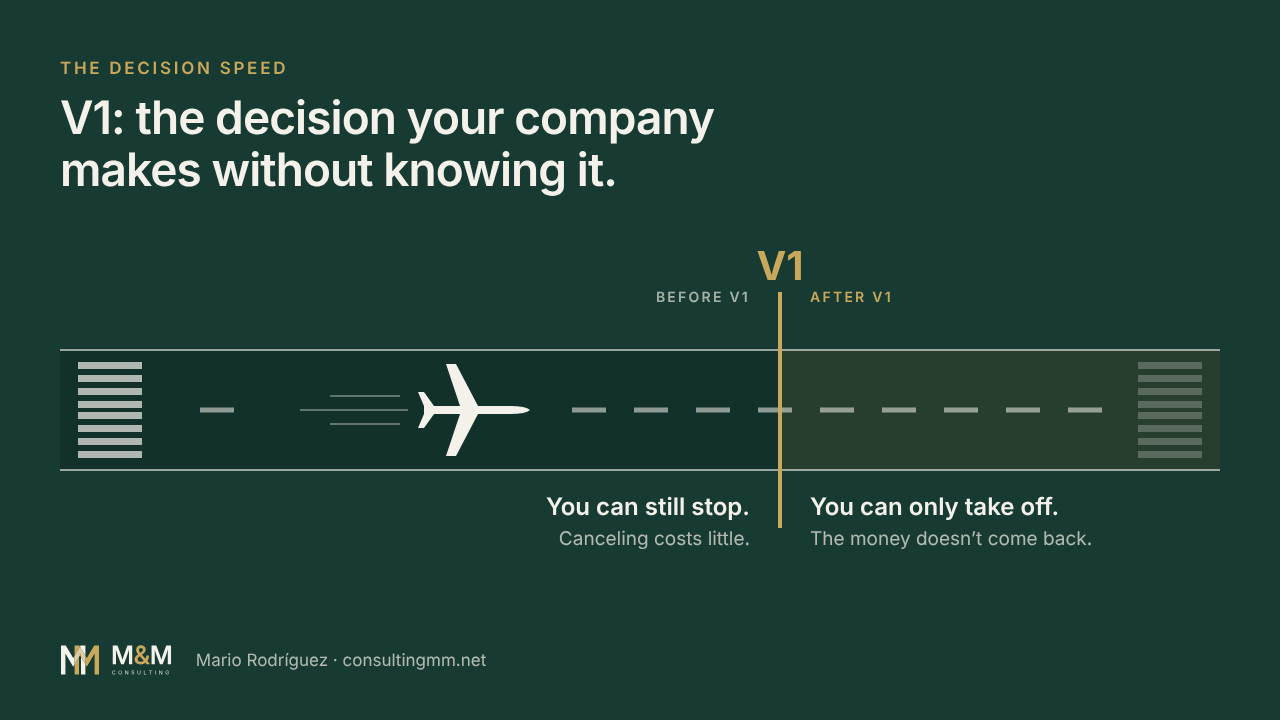
In every takeoff there is a moment when the pilot can no longer turn back.
It’s called V1. It is a specific speed, calculated before the aircraft leaves the gate, based on weight, runway length, temperature and wind. If something fails before V1, the pilot rejects the takeoff and the aircraft stops on the remaining runway. If it fails after V1, even an engine, the pilot has to take off. Braking is no longer an option, because there isn’t enough runway left.
What struck me most when I worked in airlines wasn’t the number. It was that nobody improvises it. No pilot decides at well over 120 miles an hour whether there is still room to stop. The answer is already written in the cockpit before the aircraft moves.
In most companies, it works the other way around.
Every project has its V1
Signing a lease. Paying a supplier deposit. Hiring five people. Buying the season’s inventory. Putting down a hotel deposit for an event.
Before each of those moments, canceling costs little. After them, the money doesn’t come back. The difference with aviation is that almost nobody calculates where that point is. Companies cross it without noticing, and find out when they are already in the air with an engine out.
It isn’t carelessness. It happens for three very human reasons.
The first is optimism. Expected revenue starts being treated as if it were confirmed. “The sponsor said yes” is not the same as a signed contract, let alone money in the bank. But on the spreadsheet they look the same.
The second is the calendar. The supplier wants a deposit to hold the date, the landlord needs a signature this week, the opportunity is “going away.” And when the date is in charge, the financial condition gets pushed to later.
The third is sunk cost. Once the first dollar is in, stopping feels like losing it. So the second goes in, and the third.
A real case
Some time ago I worked with an organization that produced large-scale events in several countries. Each edition had a budget of more than half a million dollars.
A large part of the revenue depended on sponsorships, and sponsorships closed late. Costs, on the other hand, were committed early: venues, production, travel and suppliers in several countries. There was no defined break-even point. Things moved forward because the event “was going to work out.”
The risk wasn’t that an event wouldn’t sell. It was that, by the time anyone knew, almost all the money would already be committed.
What we did was fairly simple to explain and fairly demanding to sustain.
First, we mapped every commitment with two pieces of data: how much money it involved and from what date it could no longer be recovered. A deposit refundable up to 90 days before the event is not the same as one that is lost the moment it’s signed. That list alone was revealing: most of the money became irreversible weeks before the sponsorships came in.
Then we built three scenarios, conservative, base and expansion, each with an explicit break-even point. The discussion was no longer whether the event was profitable in general, but how much had to be sold and sponsored to avoid a loss in each case.
With that, we set gates. Each block of spending was released only when a level of confirmed revenue covered it. Confirmed meant money in the account, or collections dated in a signed contract and discounted for the risk of delay. Not promises.
Each initiative had its own V1: a date and a condition. If the condition wasn’t met by that date, the format was scaled down or the edition was moved. No drama, because the decision had already been made in advance.
And so as not to depend on anyone’s memory, we set up a dashboard showing three things: what share of revenue depended on sponsorships, how long each commitment took to turn into cash, and what contractual obligations were open in each country.
The events were executed within the defined financial limits. Margins were protected, there were no cost overruns and liquidity stayed stable. What started as a control for one edition became the model for every edition after it.
But the change I remember most isn’t in the numbers. It’s in the meetings. The question went from “do you think it’ll work out?” to “have we cleared the gate?” The first one is answered with faith. The second, with data.
How to find the V1 of your next decision
You don’t need special software. You need to answer five questions before committing the money, not after.
- What commitments am I about to take on, and from what date does each one become unrecoverable?
- How much of the revenue is confirmed, how much is probable and how much is only expected? Only the first kind pays invoices.
- What is my break-even point in the conservative scenario, not the one I’d like to see?
- What condition has to be met before crossing? For example: “we don’t sign the lease until confirmed revenue covers a set percentage of first-year fixed costs.” The percentage depends on each business. What matters is that it’s written down beforehand.
- Who decides, and on what date? A V1 without a date and an owner is just a wish.
It works for opening a new location, hiring a sales team, launching a product, buying inventory or signing a five-year lease. Any decision with a before and an after.
And after you cross
Aviation has another concept that often gets confused with V1: the point of no return. In flight, it is the point beyond which the fuel is no longer enough to return to the departure airport. From there, the aircraft can only continue to its destination or divert to an alternate.
No pilot reaches that point without knowing their alternate. It was set on the ground, together with the fuel needed to get there.
It’s the same in a company. Calculating V1 helps you decide whether to cross. But once you have crossed, going back is no longer an option, and the question changes: if things don’t go as expected, what is my alternate? Scale down the format, postpone a phase, renegotiate a contract? And how much cash do I need to get there?
Neither concept removes risk. What they do is let you take it on when you decide, with numbers worked out on the ground and not in the middle of the takeoff roll. Deciding in advance isn’t pessimism. It is exactly what lets you accelerate with confidence.
In the MR³ method we work with both ideas: the moment a commitment becomes irreversible, and the alternate plan for when there’s no turning back. But you don’t need any method to start. A sheet of paper and an honest question are enough.
One question to finish
What is your company’s next decision that won’t have a way back? Do you know on what date you’ll cross it, and under what condition?
Note: the MR³ method is now called the Prevuelo™ Method. The ideas in this article are unchanged.
MR³ Index
Before your next big decision, measure where your company stands in 5 minutes.